Paper or an app is the wrong first question. The first question is whether the diary gets filled in at the time, with every trip, for every day you were asked for. Both formats, the paper sheet and a digital bladder diary in an app, can do that and both can fail at it. This article goes through what the research actually found when it compared them, what a recent review of bladder apps found missing, and how to choose without ending up with half a diary on paper and half on a phone. We make an app, so read the last section with that in mind.
What paper does well
Clinics know it. The form arrives with the columns the clinic wants, in the clinic’s own scale for urgency or leaks, and the clinician can write on it. There is nothing to install or learn, it works in a hospital bathroom with no phone, and the person filling it in can be eighty and never have owned a smartphone. For a three-day diary handed over with the appointment letter, paper is a perfectly good tool.
Where paper fails
It gets filled in later. The clearest evidence comes from a study that hid a sensor in a paper diary binder to record when it was actually opened: patients reported filling it in as instructed the vast majority of the time, but the binder showed they had done so on only a small fraction of the scheduled occasions, with many entries written in batches afterwards.1 Bladder diary research has seen the same tendency from the other side: in trials comparing three-day and seven-day diaries, the authors note that the shorter diary may reduce the temptation to fill gaps from memory.2 Memory, for this purpose, is poor.
The other failures are practical. The sheet is not in the bathroom at three in the morning. Totals and night counts have to be added up by hand, or not at all. And a diary on a kitchen table is easy to lose and easy to leave at home on the day.
Are electronic bladder diaries more accurate than paper?
Electronic diaries entered the research literature early. An electronic daily diary for overactive bladder, tested in 2003, collected symptom data with time stamps and was rated easy to use, with the authors pointing to real-time data as its main advantage over paper.3 A randomised trial that compared an electronic voiding diary with paper in women with urinary symptoms found both reliable on repeat testing, with slightly fewer voids and leaks recorded electronically, and concluded that the electronic version was acceptable and reliable.4 In other words: not magic, but a sound alternative, with the time stamp as the concrete gain.
What a review of apps found lacking
That the format works does not mean every app does. A 2026 analysis of bladder diary apps against the content of validated paper diaries found that most apps lacked important clinical items, had no professional involvement, and were weak on the security of health information, and concluded that further development was needed before apps matched validated paper diaries.5 The literature is also honest that no fully validated diary exists in any format, paper included.7
The practical reading: judge an app by whether it records what your clinic’s form records, not by its ratings. The list is short:
- Time on every entry, set automatically and editable when you log late.
- Trips without a volume, so a tick in a public toilet is still an entry.
- Bed and wake times, or a night marker, so nights can be counted.8
- Somewhere for urgency, leaks and pads, as fields or at least as notes.
- An export the clinician can read: a printable report, or a table you can email.
- What happens to the data: an account, a server, advertising. The App Store privacy label tells you in one line.
- Whether logging is ever interrupted, by sign-ups or by prompts to pay.
How to choose, honestly
If your clinic gave you a form with its own scales, use the form. If you were told “keep a diary” and left to it, choose the format you will actually have with you at the moments that matter, which for most people is the phone. Whichever you choose, choose it once: a diary split between a sheet and a screen is two half-diaries, and neither adds up. The burden of keeping a diary is real,6 and the format that lowers it for you is the right one.
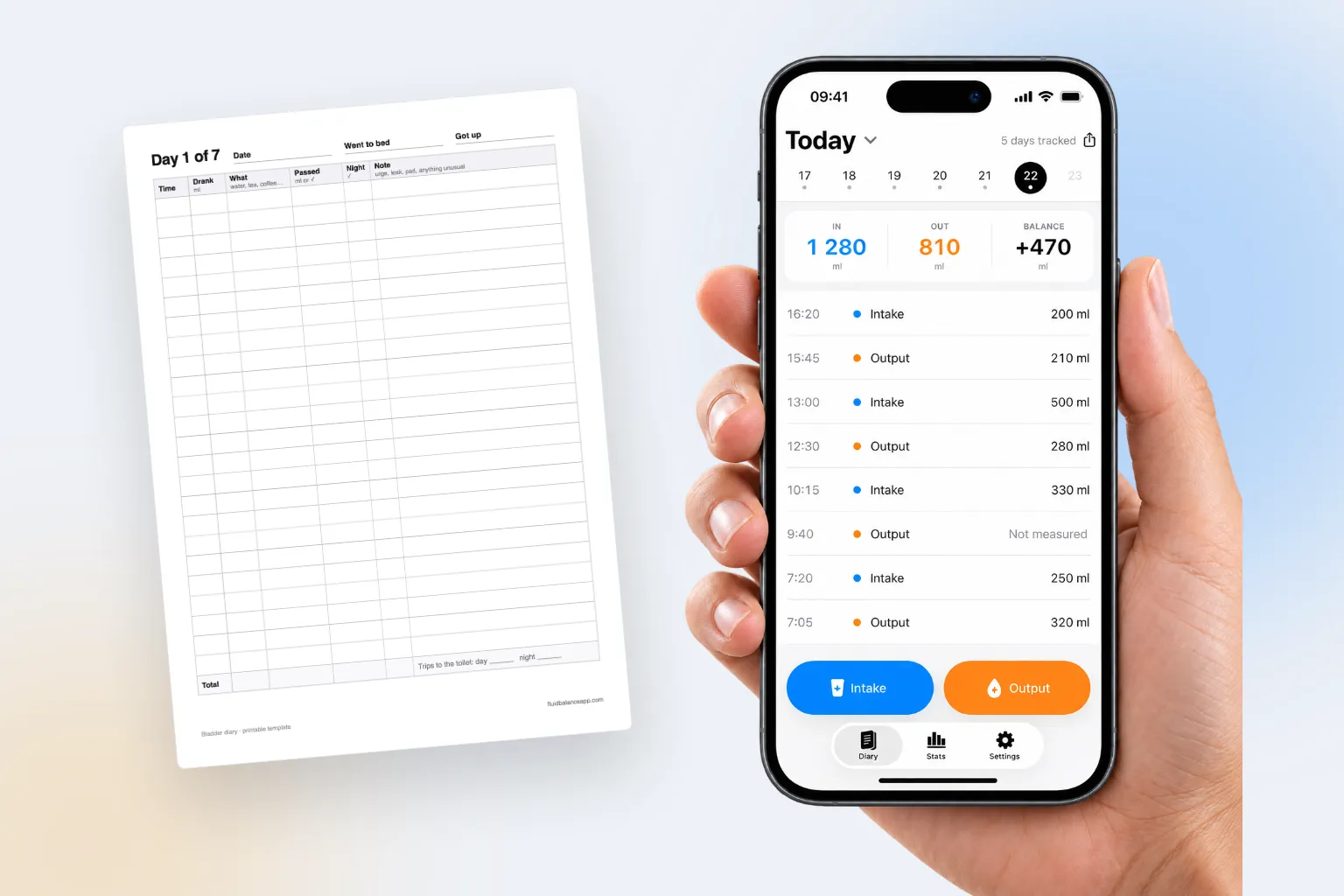
Our own position, stated plainly: Bladder Diary: Fluid Balance logs a trip in two taps with the time attached, counts nights, does the totals and prints a report, and its privacy label is Data Not Collected. Urgency has a field of its own, an optional rating from 0 to 4; leaks and pads go in a note. If you prefer paper, the free template has the same columns, so the two read the same way and a clinician sees no difference in structure. Either way, what makes the diary useful is the same thing the studies keep finding: fill it in when it happens.