Free printable bladder diary
A bladder diary template for the 3–7 day record a doctor, nurse or pelvic-floor therapist asks for. Print it, keep it by the toilet, bring it to the appointment. Free download, no email.
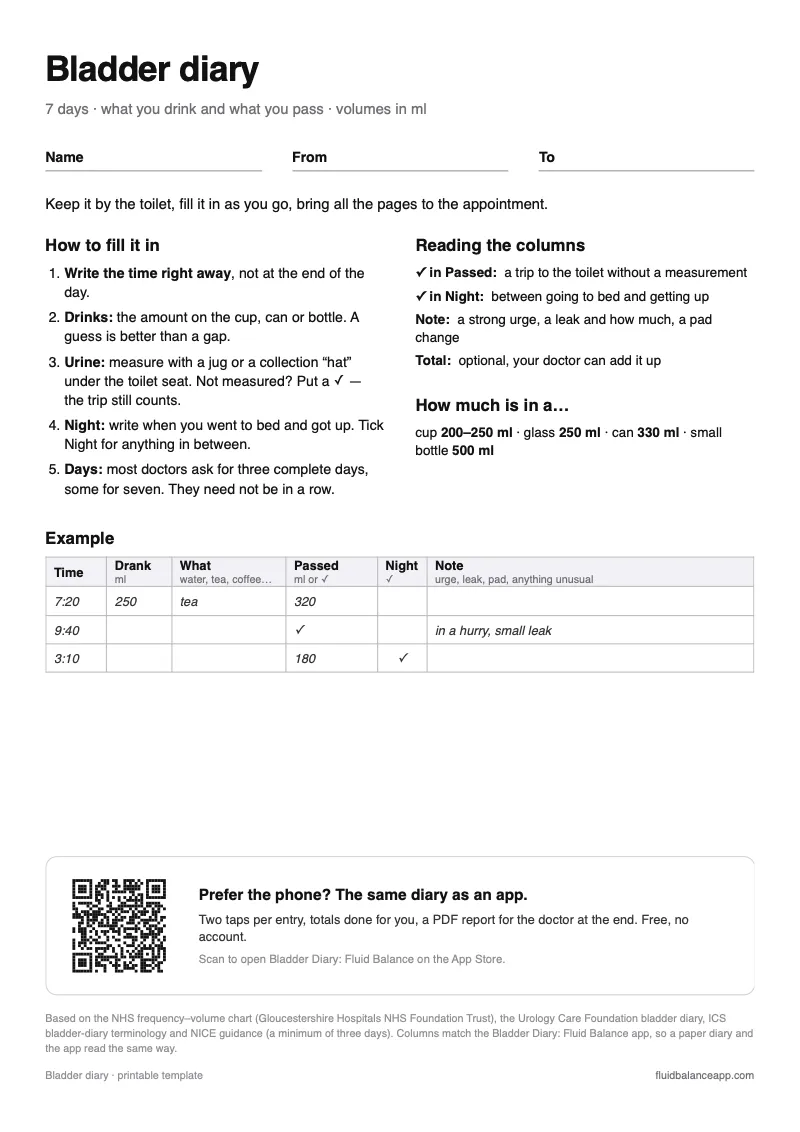 Full pageA4 · ml8 pages, one page per day
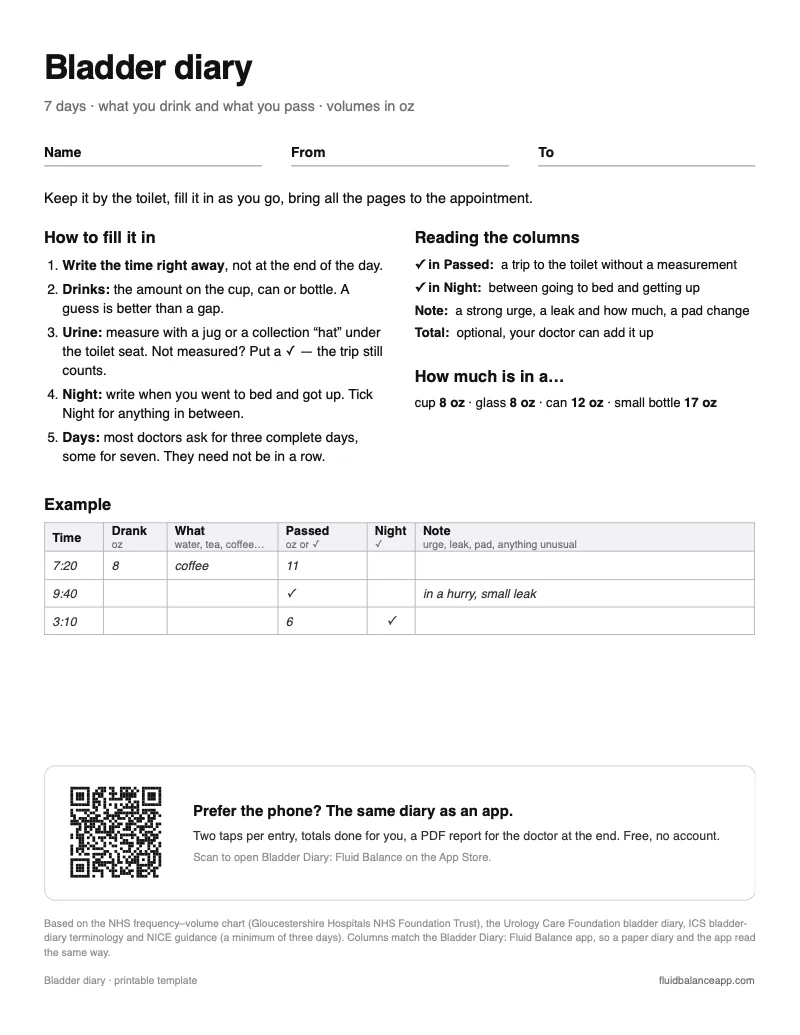 Full pageUS Letter · oz8 pages, one page per day
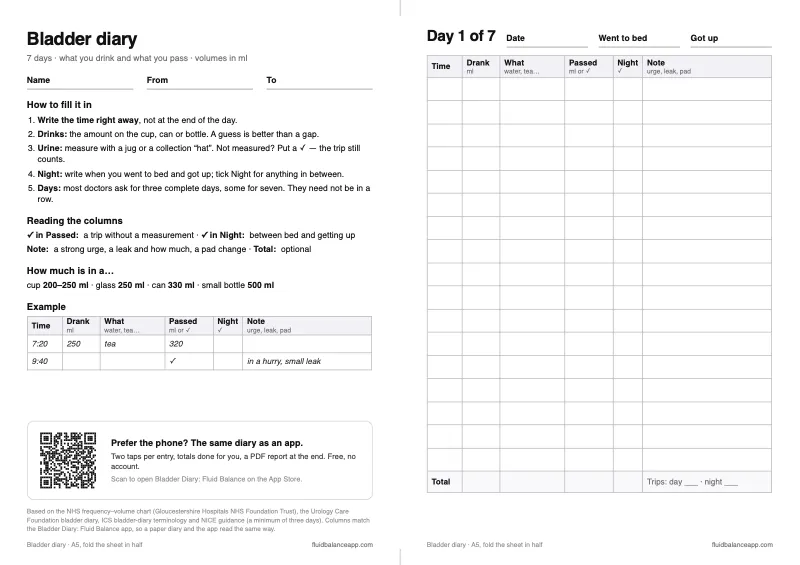 Fold in halfA5 booklet · ml4 landscape A4 sheets, fold in half
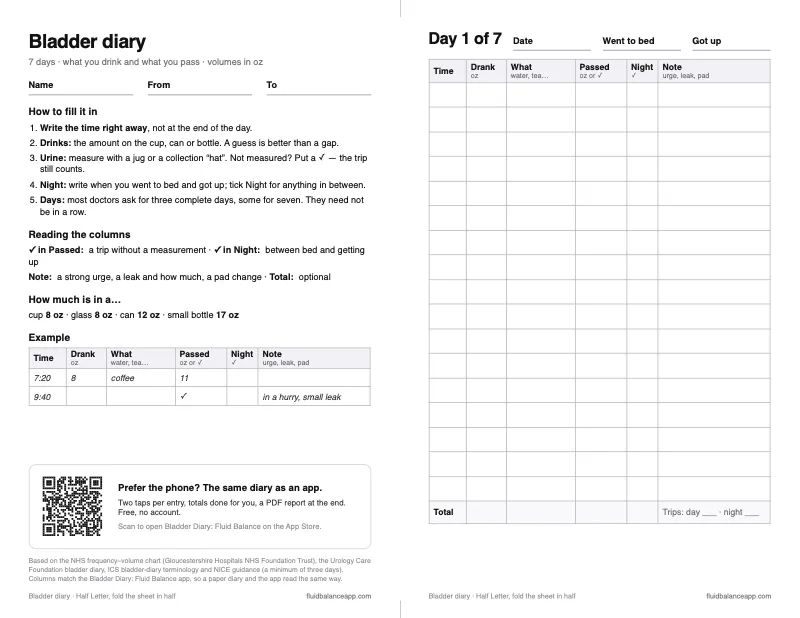 Fold in halfHalf-Letter booklet · oz4 landscape Letter sheets, fold in half
Free PDF, no email, no sign-up. Print at 100 %. A4 sheets are in millilitres (UK, Europe, Australia), US Letter sheets in fluid ounces. Booklets: print on landscape paper and fold each sheet in half.
What's on the sheet
Seven days, one page per day. Columns: time · what you drank · what you passed · night · note. At the top of each page, the day number, the date and the times you went to bed and got up; on the last page a line for days recorded ▢ of 7 — the first thing a doctor checks. The first page explains how to fill it in, with an example. Clinics call the same sheet a voiding diary template, a bladder diary sheet or chart, or a frequency–volume chart; a 3-day bladder diary is simply the first three pages. The columns are the ones they expect.

How to fill it in
Write the time right away
Not at the end of the day. The time of each entry matters as much as the amount.
Drinks: use the amount on the cup or bottle
A cup is about 200–250 ml, a glass 250, a can 330, a small bottle 500.
Urine: measure if you can, estimate if you can't
A measuring jug or a collection "hat" in the toilet bowl works. If you didn't measure at all, tick "not measured" — the entry still counts.
Mark night entries
Anything between going to bed and getting up in the morning.
Four steps are enough to start. The full guide, with a worked example and the mistakes that spoil a diary: how to keep a bladder diary, step by step.
Three days or seven?
Most guidelines ask for a 3-day diary with complete days; some doctors ask for seven. Complete matters more than long — follow what you were asked. Why three, and when seven makes sense.
What it's based on
The layout follows the diaries urology services already use, so your doctor finds everything where they expect it:
- Frequency–volume chart, Gloucestershire Hospitals NHS Foundation Trust — the ✓ for a trip without a measurement, bed and wake times, a worked example.
- Bladder Diary, Urology Care Foundation (American Urological Association) — free rows instead of a fixed hourly grid, container sizes as reference amounts, days that need not be consecutive.
- International Continence Society, bladder-diary terminology — what a bladder diary records, and bed and wake times to count night trips.
- NICE quality standard QS77 — a diary of at least three days.
Columns match the Bladder Diary: Fluid Balance app, so a paper diary and the app read the same way. Compiled by the app's developer, not a clinician. If your clinic gave you its own form, use that one.
Or keep it on your phone
Two taps per entry, the same columns, and a PDF report at the end. Nothing leaves your phone.