Nobody can tell you which free bladder diary app is best for you, and in this corner of the App Store most of the best-app lists are published by apps that appear in them. What you can settle before you install anything is whether an app will still help on the day you hand the diary to a clinician. That depends on what it records, how many days it holds, what happens to your entries, and whether you can get the diary out at the end. We make one of these apps, so read the last two sections with that in mind. The checks before them work on any app, ours included.
What does free mean in a bladder diary app?
Four different deals go by the same word, and the App Store page tells you which one you are looking at before you download anything.
Some apps are free outright, with nothing to pay and nothing to unlock. Some are free because advertising pays for them, including at three in the morning, in a bathroom, half way through an entry. Some give you a trial of a week or two, after which recording stops or locks what you have already entered, part way through the consecutive days the clinic asked for. The most common arrangement is free to record and paid to get the diary out: logging costs nothing, and the report, the export or the charts sit behind a purchase.
Two lines on the App Store page settle which one you have: the In-App Purchases list, which names what is sold and whether it renews, and the privacy label. A diary is usually a job of a few days, so a subscription and a one-time purchase are not the same deal.
What the diary has to record
The clinic’s form has a column for how much you passed, in millilitres, and that is the column an app is most likely to leave out.
The European Association of Urology separates two documents in its guideline on male lower urinary tract symptoms. A frequency volume chart records the time and volume of each void; a bladder diary adds fluid intake, pad usage, activities and symptom scores, and the guideline asks for at least three days of it.1 The International Continence Society describes the bladder diary the same way: voided volumes with times, plus incontinence episodes, pad usage and intake.2 A review of the evidence on diary content, format and duration makes the same point: what the diary is for sets what it has to contain.3
An app that counts taps gives you a number of trips. That is one line of the chart the clinic asked for, and the measured volumes are the part nobody can reconstruct afterwards. So the first thing to look for in the screenshots is a numeric volume field, in millilitres or ounces, and a way to record a trip you could not measure. Without the second one people skip the entry altogether, and a missing record is worse than an approximate one.
Seven checks before you install
- A volume on every trip, in millilitres or ounces, with a way to mark a trip you did not measure.
- The time attached automatically, and editable when you log half an hour late.
- Nights separated from days: a night marker, or bed and wake times.
- Three to seven days in one diary, because that is the range clinics ask for. The research comparing three-day and seven-day diaries found the shorter one gives comparable measurements with better compliance.4
- Somewhere for urgency, leaks and pads, as fields or at least as a note.
- An export a clinician can read: a printed page or a PDF, not a screenshot of a chart.
- The privacy label, and whether an account is required at all before the app will record anything.
Those seven take about two minutes on the App Store page, and none of them is what the best-app lists sort by.
What free costs you later
The common failure comes on the last day: three days recorded, and then the report sits behind a payment you did not expect, or the entries will not leave the app in any form a clinician can read.
A 2026 framework analysis of electronic bladder diary apps found that most of them lacked important clinical items, had no professional involvement in their design, and were weak on the security of health information, and concluded that apps were not yet a match for validated paper diaries.5
The check costs nothing. On day one, before you have anything to lose, open the export or report screen and see what happens. If it asks for money, you still have the choice of another app and no entries to move.
Is a free app enough for the appointment?
Yes, when it holds the time and volume of each trip, keeps the nights apart, covers the days you were asked for, and hands the result over in a form someone can read. Clinics ask for the diary because it is a record of what happened rather than what you remember,6 and a free app with every trip in it beats a paid one with gaps on the second night.
No app should interpret the result. Your numbers mean something next to your history, and that reading belongs to your clinician.
What is free in Fluid Balance, and what Pro adds
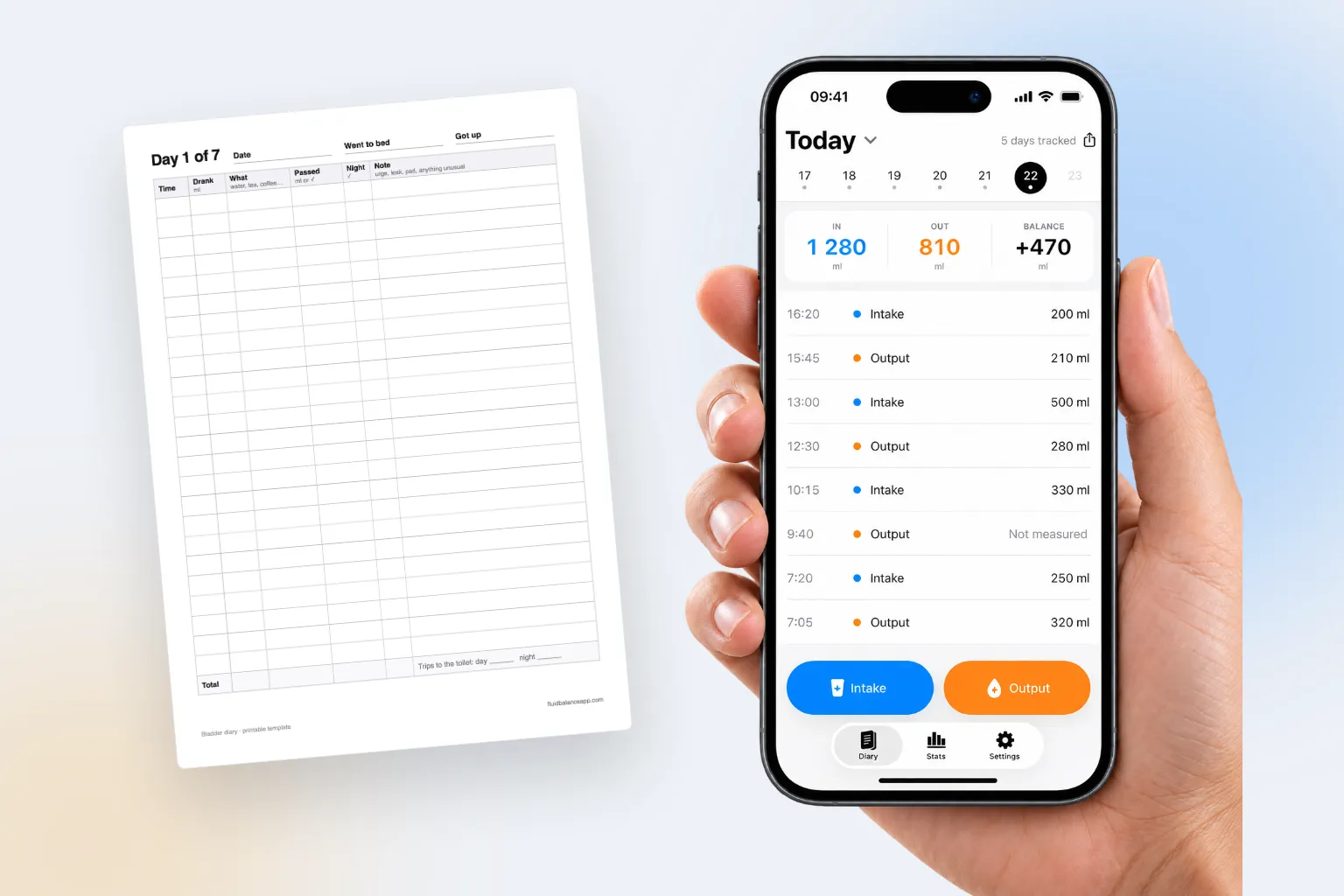
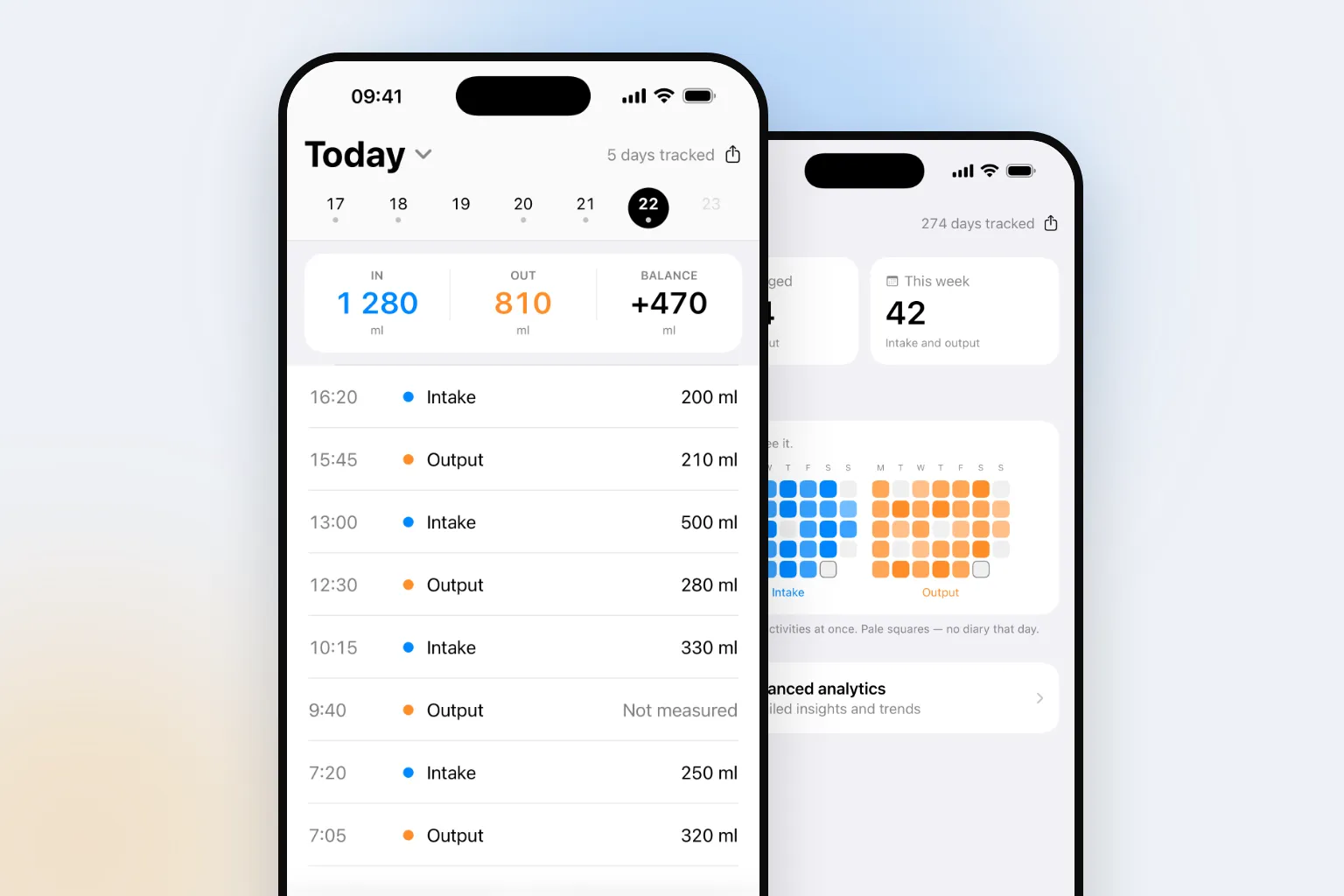
Free, for as long as you use the app: logging intake and output in two taps with presets and a Not measured option, the optional urge rating from 0 to 4, the Today screen, the statistics grid, Home Screen and Lock Screen widgets, the Apple Watch app, iCloud sync without an account, CSV export, and 12- or 24-hour time. The privacy label is Data Not Collected: no account, no server, no analytics in the app.
Pro is a one-time purchase, not a subscription: it adds the PDF report for your doctor, the Advanced analytics page (the first weekly chart is free) and a dark app icon. Nothing interrupts an entry to ask you to upgrade, ever. You can see all of it on the first run, and what the app looks like screen by screen is on its own page.
If you would rather not install anything
The free printable template has the same columns: A4 in millilitres, US Letter in ounces, fold-in-half booklets, one page per day with the instructions on the sheet. A clinician reads it exactly as they read the app’s report, which is the point of keeping the two identical.
Either way, the best free bladder diary app for you is the one with every trip in it on day three and a report you can print.