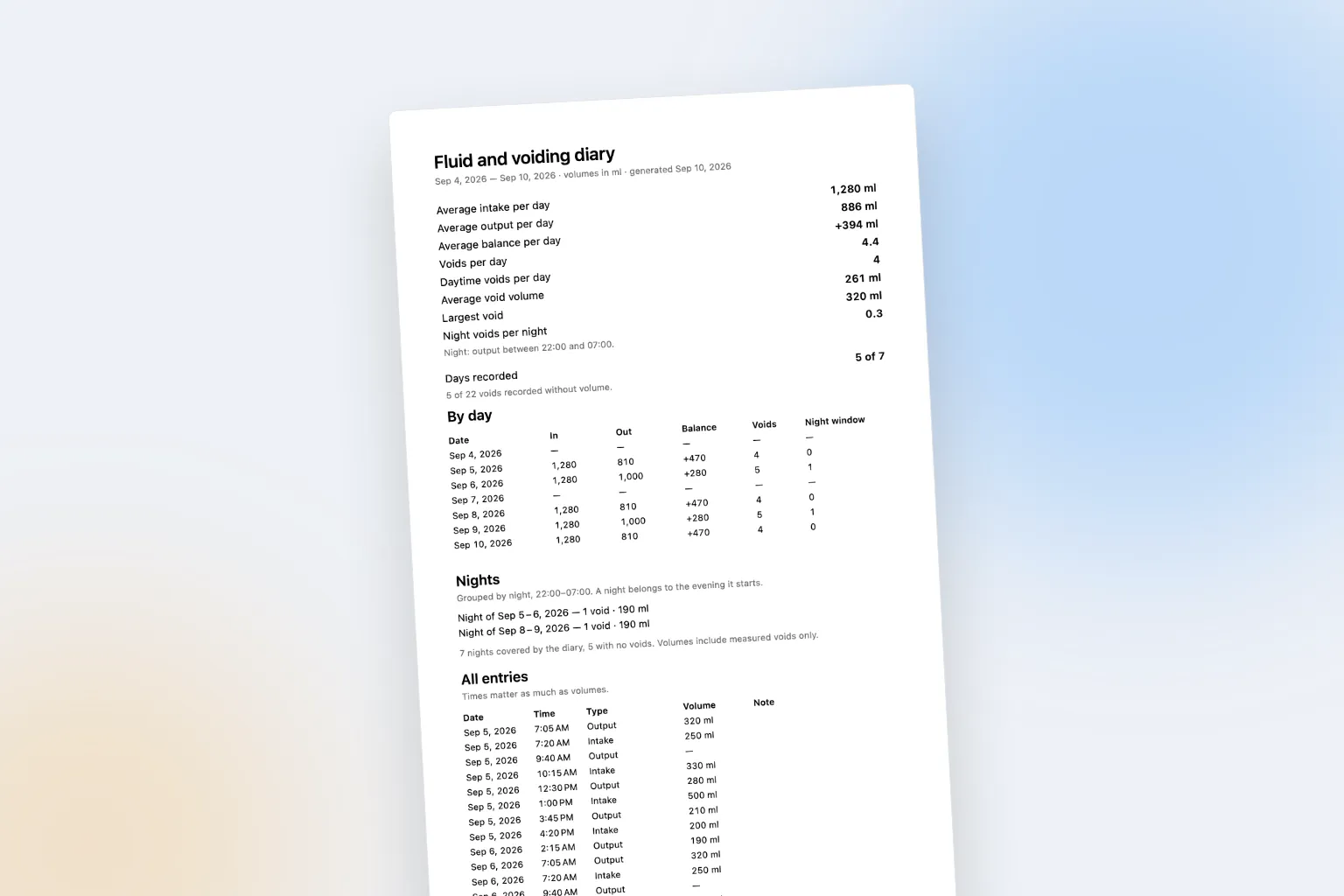
A bladder diary shows a clinician five things: how often you go, by day and by night; how much you pass each time; how much of your urine is produced at night; what you drink and when; and how complete the record is. Nothing on this page says what any of those numbers should be, and it does not interpret bladder diary results. That reading belongs to the clinician who knows your history; what a bladder diary is used for is putting those five things in front of them. This article explains what they look at, so that every column on the sheet makes sense while you fill it in.
What is a bladder diary used for?
The International Continence Society defines the terms a diary is built on: daytime frequency, nocturia, voided volume, and the frequency–volume chart that records them.1 Research on these charts has settled on a handful of variables that are read again and again: the number of voids by day and by night, the volume of each void, the largest volume, and the total over 24 hours.2 Guidelines then tell clinicians to ask for the diary: the European Association of Urology recommends a bladder diary of at least three days in the assessment of male urinary symptoms, particularly for nocturia,3 NICE asks for one when women present with urinary incontinence,4 and the American guideline on overactive bladder includes it in the evaluation.5
1. How often you go, day and night separately
The first count is trips per 24 hours. The second, and often more important, is how many of those happened at night: the International Continence Society defines nocturia as waking at night to pass urine, each trip preceded and followed by sleep.1,6,7 That is why every diary asks when you went to bed and when you got up. Without those two times, the night trips cannot be separated from the daytime ones, and half of what the diary is for disappears.
Trips you couldn’t measure still count here. A tick with a time is a full entry for this purpose; a missing line is not.
2. How much you pass each time
Each measured volume tells the clinician something on its own, and together they give two more figures: the largest volume you passed during the diary, and the spread between the smallest and the largest.2 A run of small volumes and a run of large ones are read differently, and both are read against everything else the clinician knows about you. This is the part of the diary that a jug or a collection hat makes possible; how to measure at home covers the practical side.
3. How much urine you make at night
Clinicians add up the night-time volumes separately. By the ICS definition, the night-time urine volume includes the first void after getting up in the morning, because that urine was produced during the night, even though the trip itself happens after waking.6,7 From the night volume and the 24-hour volume they calculate the share produced at night, and from the times they can see how long you slept before the first trip.8 These are calculations, not verdicts: the figures are compared with your age, your sleep and your medical history, and the thresholds they use are theirs to apply.
4. What you drink, and when
The intake side is read for pattern rather than total: how the drinks are spread across the day, what they were, and how the evening looks. Clinic forms ask for the type of drink for the same reason.1 The clinician is looking at whether what went in and what came out line up in time; that is a question about your record, not a judgment about your habits.
5. Notes: urges, leaks, pads
Where the diary form has columns for urgency, leaks and pad changes, they are read as events with a time attached. The ICS defines these terms too: urgency as a sudden compelling desire to pass urine that is difficult to defer, and incontinence as any involuntary leakage.1,10 A note that says “leaked when I coughed” or “strong urge on the way home” is exactly the kind of line the second read-through is for.
The check that comes first: is it complete?
Before any of the above, a clinician looks at how much of the diary is there: how many days are filled from waking to waking, how many trips have volumes, how many are ticks. A diary with two complete days is read; a diary with five days of scattered lines is a conversation about doing it again. Clinicians rely on the diary precisely because memory is poor at this: in one study, half of the women asked overestimated how often they went during the day when compared with their own diaries.9 Our template has a “days recorded” line on the last page, and the app counts recorded days for the same reason.
Why you won’t find normal numbers here
Two reasons. First, there is no single validated diary, and clinics use different forms, different day lengths and different definitions of night;11,12 a number from one form does not transfer cleanly to another. Second, and more important, every figure in a diary is read against the person: age, fluids, medicines, sleep, other conditions. A frequency that is unremarkable for one person is the key finding for another. Publishing a table of “normal” values would invite you to grade yourself with a tool that was never designed for that. The diary is a record. Reading it is the appointment.
Bringing it in
Bring every page, say which days are complete, and, if you used an app, print the report or have it ready on the phone. How to keep a bladder diary covers the rest: what to record, the common mistakes, and what to do about the days that went wrong.