A nocturia diary is an ordinary bladder diary with the night recorded properly. If you were asked to keep one because you get up at night, the night is the part of the diary that matters most, and it is also the part people record worst: half asleep, in the dark, with no wish to hold a jug. This article is about getting the nights right with the least effort. It does not say how many trips are too many; that question is for the clinician who asked for the diary.
What counts as a night trip
The International Continence Society defines nocturia, night-time urination, as waking at night to pass urine: each trip is preceded and followed by sleep.1,2 The diary turns that definition into two times, when you went to bed intending to sleep and when you got up for the day, and everything in between is the night.
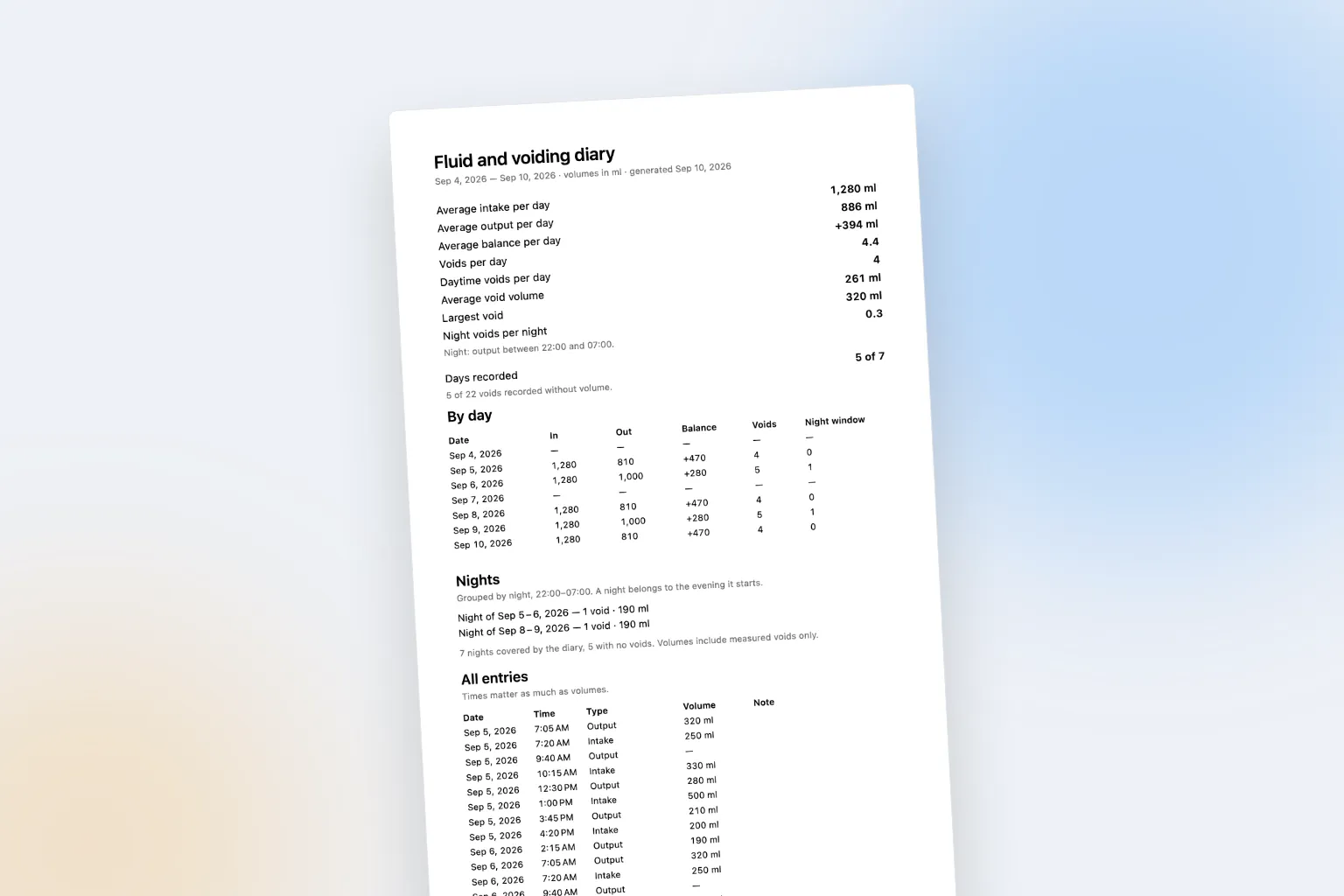
That is why every form asks for those two times. The NHS chart has you write BED and WOKE in the time column;8 the BAUS chart asks for two lines across the day’s column;9 our printable template has a box for each at the top of every page and a Night column to tick. The app counts night trips inside a fixed window, 22:00 to 07:00, and says so on the report. If your nights run on a different clock, write your real bed and wake times in the notes, or use the paper sheet; the clinician needs your night, not a default one.
Why the diary, and not just telling the doctor
Guidelines are unusually direct about this. The European Association of Urology recommends a bladder diary of at least three days to assess male urinary symptoms, “particularly for nocturia”, because the diary is what allows the clinician to tell the different causes of night-time trips apart.3 A systematic review of nocturia found that objective tools like the frequency–volume chart are underused, and that the assessment suffers for it.4 Memory is better for nights than for days,10 but a count is not the same as a record with times and volumes, and it is the volumes that carry most of the information.
The first trip of the morning
The trip you make after getting up is not a night trip: you were already up.1,2 But the urine you pass then was made during the night, so by the ICS definition its volume is added to the night-time urine volume.1 On paper, write it as the first line after your “got up” time, with its volume if you measured it. You don’t need to do any arithmetic with it. The clinician will, which is why that first measurement is worth the jug.
What to write for each night trip
- The time. Look at the clock before anything else. If you can’t remember it in the morning, write your best guess and mark it “approx.” in the note.
- The volume, if you can. A collection hat left under the seat before bed catches it without you holding anything; read it in the morning if you must, but write the time straight away.6,7
- A tick, if you couldn’t measure. A ticked night trip still counts as a trip.
- A note when something is unusual. “Awake anyway”, “woke with a strong urge”, “leaked before I got there”, pain. The clinician reads these lines.
What the clinician calculates from the nights
From your times and volumes they work out how much urine you made at night, what share of the 24-hour total that is, and how long you slept before the first trip.1,2,5 These figures are the reason the two times and the first-morning volume matter so much: without them, the night trips are just a count, and a count is what the diary was meant to improve on. The thresholds the clinician applies to those figures depend on age and on the rest of your history, and are theirs to apply.
How many nights should a nocturia diary cover?
At least three, by the EAU recommendation and by most clinic forms.3,8,9 More nights give the clinician a better sample of a pattern that varies from night to night; a week is common when nocturia is the main question. Whatever the number, each night should be complete: bed time, every trip, wake time. How many days a diary should cover goes through the guidance in detail.
Don’t change your evenings for the diary
If you usually have tea at nine, have tea at nine. A diary kept on unusually dry evenings shows the clinician a pattern you don’t actually live with, and the appointment starts from the wrong picture. Record the evening drinks with their times and amounts; how the evening intake relates to the night trips is one of the things the diary exists to show.
Making it easier
Put the hat in place and the pen on top of the sheet before bed. Leave a small light on. If the sheet is not by the toilet, the phone is: the app’s Lock Screen widget and the Apple Watch app log a trip in two taps without unlocking anything, and the time is recorded for you. Whichever you use, the rule is the same: time first, volume second, and never skip the line.