You were told to keep a bladder diary. The leaflet says frequency–volume chart. The website you found says voiding diary or voiding log, and the nurse on the ward called it an input/output chart. They are, for your purposes, the same sheet. The differences that do exist are small, defined, and explained below, so that you can stop worrying about the label and get on with the columns.
The short version
| Term | What it records | Who tends to say it |
|---|---|---|
| Micturition time chart | Only the time of each trip, day and night | Research, some clinics |
| Frequency–volume chart (FVC) | Time and volume of each trip | UK urology, NHS forms, BAUS |
| Bladder diary | Times and volumes plus drinks, leaks, pads, urgency | UK and international guidelines, NICE |
| Voiding diary, urinary diary, micturition diary | Same as bladder diary | US clinics and literature |
| Bladder record chart, bladder chart | Same as bladder diary | Physiotherapy services |
| Input/output chart, fluid balance chart | Drinks and urine over 24 hours; in hospital also drips and other losses | Wards and nursing; BAUS uses the name for its FVC |
What is the difference between a bladder diary and a frequency–volume chart?
The International Continence Society, which sets the terminology urologists use, describes three levels of record.1,3 A micturition time chart notes only the times of trips, day and night, for at least 24 hours. A frequency–volume chart adds the volume of each trip. A bladder diary adds fluid intake, pad use, incontinence episodes and the degree of incontinence, and may also record urgency and the activities that went with a leak.1,2,3 Each level answers more questions than the one before, and the bladder diary is the one most guidelines mean when they ask for “a diary”: NICE, for example, asks women presenting with urinary incontinence to complete a bladder diary for at least three days.10
Why there are so many names
Partly geography, partly history. A review of the research literature had to search for nine different terms to find the same kind of record: micturition chart, micturition diary, frequency volume chart, bladder chart, bladder diary, urinary chart, urinary diary, voiding chart and voiding diary.4 American forms tend to say voiding or bladder diary; the Urology Care Foundation’s patient form is simply “Bladder Diary”.7 British forms often keep the older clinical name even when they are full diaries: the NHS Gloucestershire chart is headed “Frequency Volume Chart, Three Day Bladder Diary” and has columns for drinks, urine, bladder sensation and pads,5 and the BAUS leaflet explains its input/output chart as “also known as a frequency-volume chart or bladder diary”.6 Physiotherapy services have their own variant, the bladder record chart, with the same content.8
Input/output charts and fluid balance charts
These two names come from the ward. A fluid balance chart is a nursing record of everything that goes into a patient and everything that comes out, including drips, drains and vomit, used to manage fluids in hospital.9 When a nurse sends you home to “keep an input and output chart” after surgery or with a catheter, they usually mean the simple version: what you drank, what you passed, with times. That is a frequency–volume chart with a drinks column, which is why BAUS can use the name for its urology leaflet.6 The columns on our printable template cover it.
The same thing in other languages
If you keep the diary in another language, the term changes but the sheet does not: Blasentagebuch or Miktionsprotokoll in German, calendrier mictionnel in French, diario miccional in Spanish, diario minzionale in Italian, 排尿日誌 in Japanese. The app runs in the same languages as this site and prints the report in the language you choose, so a German urologist gets German column headings.
What this means for you
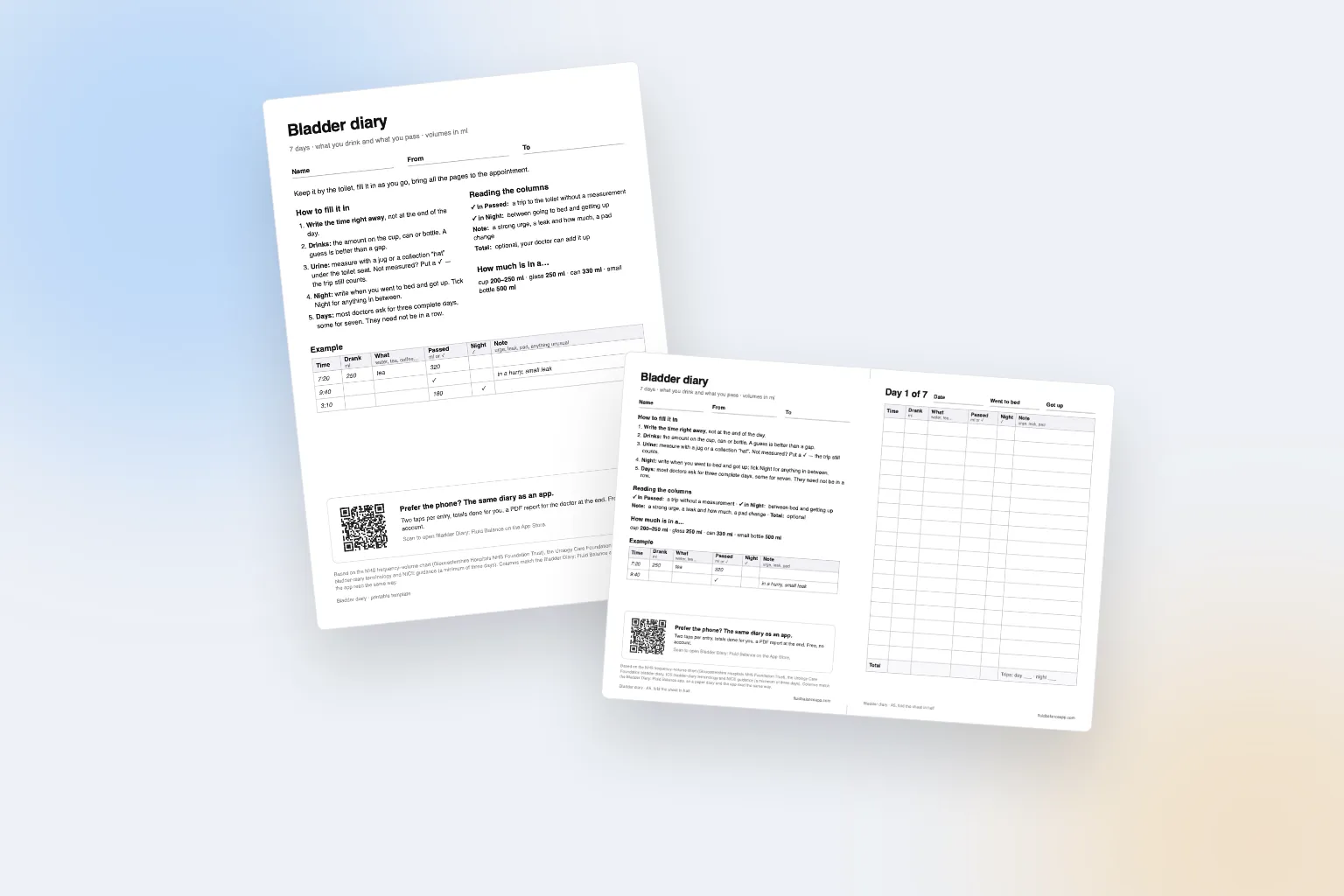
Use the form you were given. If your clinic said “frequency–volume chart” and handed you a sheet with a drinks column, fill in the drinks. If it said “bladder diary” and the sheet has columns for urgency and leaks, use them. If it gave you nothing and said “keep a diary”, any form with time, drink, volume passed, night and a note will do; that is what the template and the app both use, so a paper diary and an app diary read the same way. The label on top has never been the problem. The blank lines are.