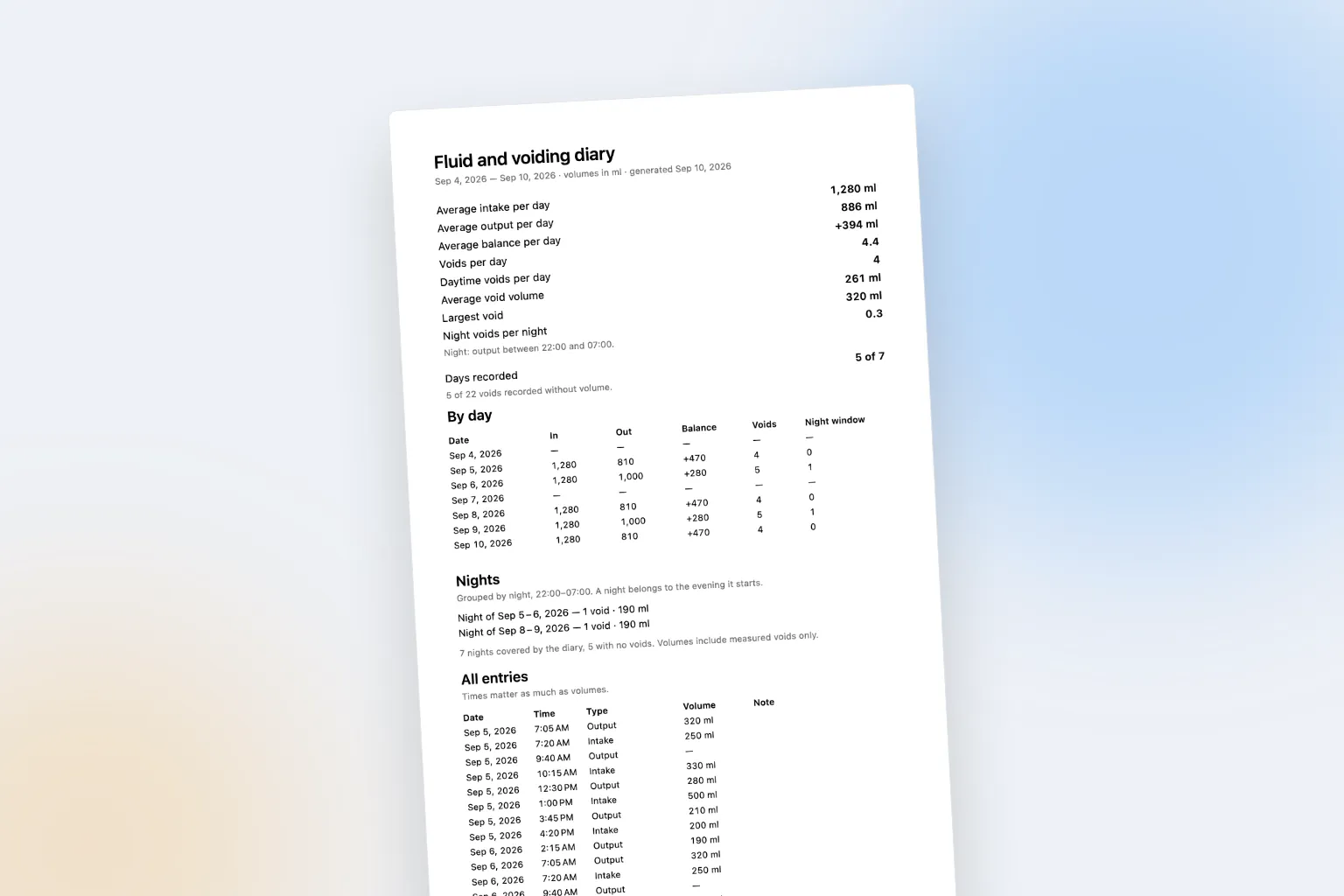
A plain bladder diary records drinks, trips and times. A bladder diary for incontinence or overactive bladder (OAB) needs four more things on the same sheet, because urgency and leaking are what the clinician is looking at: whether a trip came with urgency, whether you leaked and roughly how much, whether you changed a pad, and what you were doing when it happened. This article explains how clinic forms ask for those four, how to score them the same way every time, and where to put them when your diary has no column for them.
Why these four
The terms have precise definitions. Urgency is a sudden, compelling desire to pass urine which is difficult to defer; urinary incontinence is any involuntary leakage, and urge incontinence is leakage that comes with urgency; and overactive bladder is urgency, usually with frequency and night-time trips, with or without leaking.1,3 The American guideline on overactive bladder includes a bladder diary in the evaluation,2 and NICE asks women presenting with incontinence for a diary of at least three days and categorises the incontinence from the history: leaking with effort such as coughing, leaking with urgency, or both.4 The four extra columns are how the diary supports that sorting. “Leaked when I sneezed” and “leaked on the way to the toilet with a strong urge” are different findings, and the diary is where the difference is recorded with a time.
How do clinic forms record urgency and leaks?
Clinic forms differ in wording, not in substance.
- Urology Care Foundation (AUA). For each trip: did you feel a strong urge to go, yes or no; did you leak, and how much; what were you doing at the time, “sneezing, exercising, etc.”5
- NHS Gloucestershire. A bladder sensation score from 0 to 4: 0 no sensation, went for social reasons; 1 normal desire; 2 urgency that passed; 3 urgency, reached the toilet without leaking; 4 urgency and leaked. Plus LEAK written in the urine column, and a tick or a weight for each pad.6
- University Hospitals Sussex physiotherapy. A yes for a strong, sudden urge, and a leak severity: D damp, W wet, V very wet.7
- BAUS. A WET column with +, ++ or +++ for a small, moderate or large leak.8
The International Continence Society’s description of a bladder diary lists the same items: incontinence episodes, the degree of incontinence, pad usage, and urgency.9
Scoring the same way every time
Pick one scale, the one on your form, and use it for the whole diary. A “3” on day one and a “quite bad” on day three cannot be compared, and the comparison is the point. If your form has no scale, three levels are enough for leaks, small, moderate or large, and yes or no is enough for urgency. Write it at the time; a leak remembered in the evening tends to become “a bit” whatever it was.
Record the activity in a few words: coughing, laughing, lifting, standing up, on the way to the toilet, in bed. That is the column clinicians read to tell one kind of leak from another.4,5
Where it goes on a plain diary
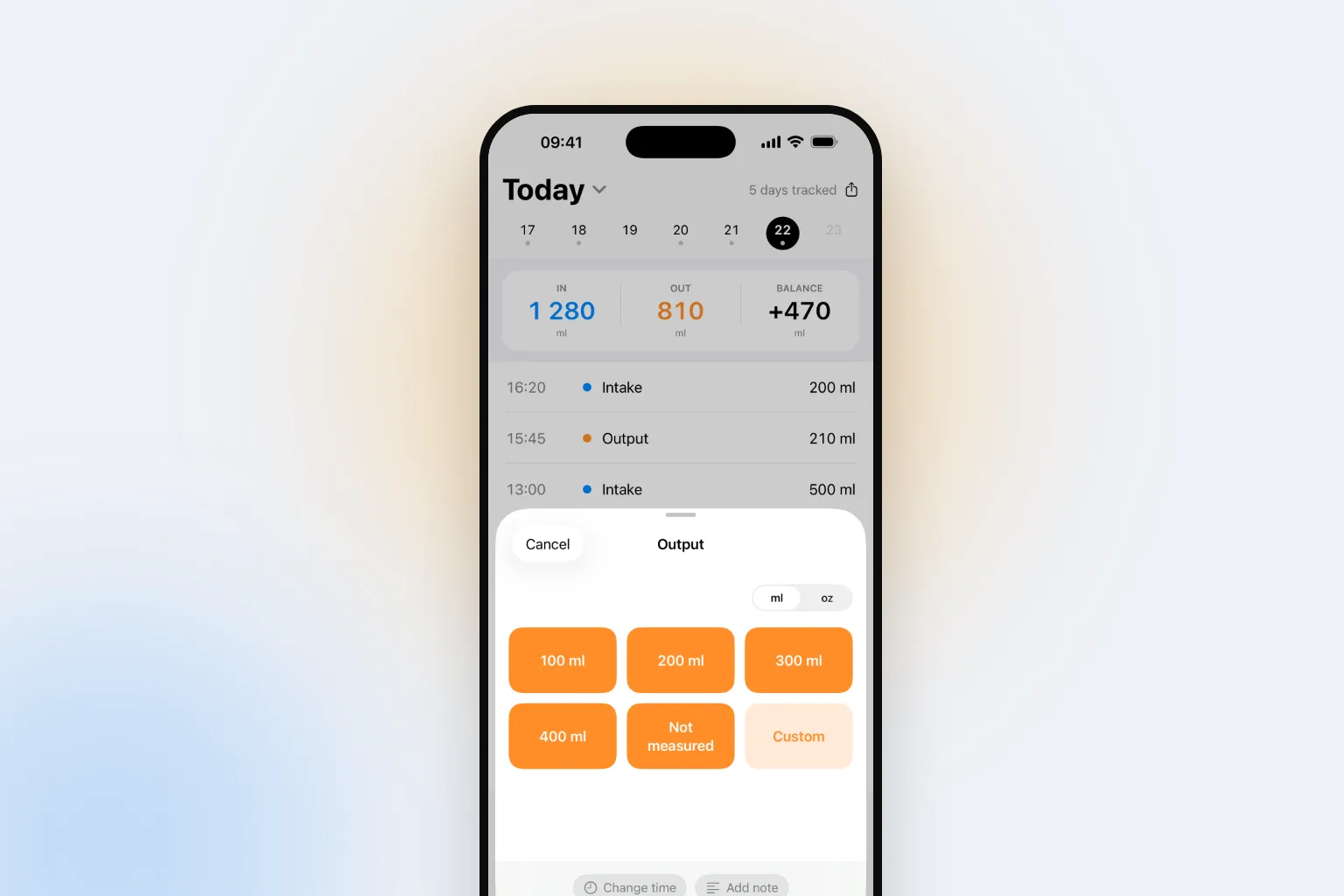
If your diary has only time, drink, volume and a note, the four items go in the note, with the time of the trip they belong to. Our printable template has a Note column labelled “urge, leak, pad, anything unusual” for exactly this, and its worked example shows a trip with “in a hurry, small leak”. In the app, urgency has a field of its own — an optional urge rating from 0 to 4, off until you turn it on — and leaks, pads and triggers go in the note; the report prints both next to their times. If your clinic wants its own scored columns, fill those in the way the form asks: a 0-to-4 urge rating is not the same scale as a form’s sensation score, and the comparison is what the scoring is for.
Night leaks and pads at night
A leak in bed is a night line: time, “leak”, how much, and whether you were asleep or on the way to the toilet. A pad changed at night is a pad line. Both belong between your bed and wake times so that the clinician can separate the night from the day; recording night-time trips explains how those times work.
Record the good days too
Leak episodes are the diary measure most affected by missing days. In a study comparing diary lengths, three days matched seven for the number of trips, the volume per trip, urgency and daily volume, but for incontinence episodes three days looked borderline;10 the fewer days you record, the more a single dry day or a single bad day distorts the picture. Record every day you were asked for, including the ones with nothing to report, and say which days are complete.
What the clinician does with it
They sort the events by kind, by time and by what triggered them, next to your drinks and your volumes, and read the whole thing against your history and examination. What they conclude, and what they suggest, is theirs; there are no thresholds on this page and no advice about what to drink or when. How to keep a bladder diary covers the rest of the record.